News
Harsh environments: what changes in the design when the operation is mining
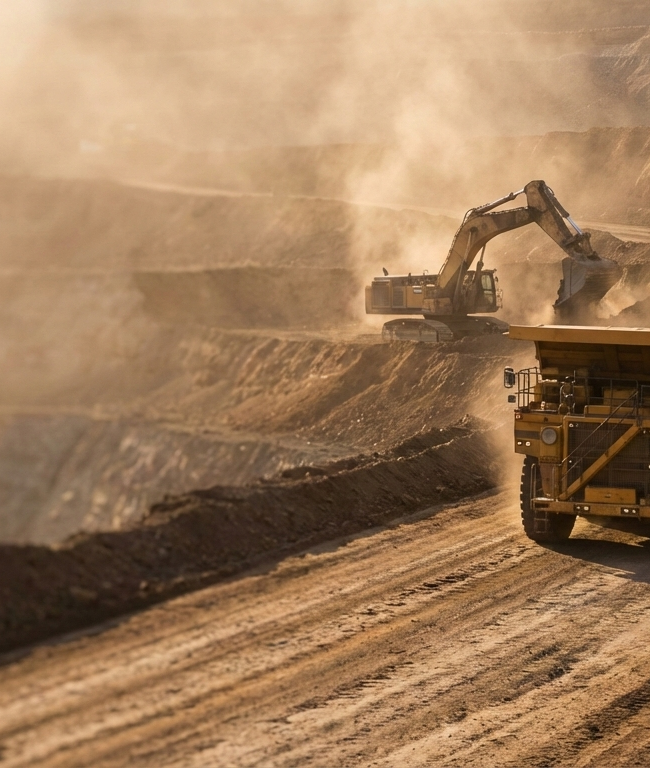
In mining, the design must be built from the start to withstand long duty cycles, contamination, impacts, and field maintenance, with reliability as a core requirement.
Mining is an environment that tests the design every single day. Equipment runs under high load for long periods, at low speeds, on uneven ground, with constant changes in traction and grade. That combination reshapes the sizing logic because loads do not occur as isolated events, they repeat in cycles and accumulate damage over time. For that reason, the technical starting point is a precise duty profile, including the work cycle, terrain characteristics, time spent in traction, and real operating loads.
Structural design moves to a higher demand level, especially regarding fatigue. Chassis twist, cyclic bending, and recurring impacts generate alternating stresses that build damage in critical regions such as welds, brackets, mounting points, and interfaces where stress concentrates. In practice, this requires rigor in defining load paths, controlling stiffness, ensuring joint quality, and aligning geometry with manufacturing processes. In mining, small detail differences can separate a predictable service life from a sequence of cracks and downtime.
Contamination and abrasion stop being background conditions and become design variables. Fine, abrasive dust finds its way through clearances, poorly positioned breathers, and sealing solutions that do not match the duty, quickly reducing the life of joints, bushings, bearings, and moving components. On the electrical side, the combination of particulate, vibration, and frequent washdowns calls for connectors, protection, and routing designed for field reality, with proper retention, mechanical shielding, and sealing that maintains performance over time. Designing for mining means treating sealing and protection as reliability-critical items.
Thermal management follows a different dynamic because typical operation reduces available cooling airflow and keeps the system under high load for longer durations. That raises the requirements for cooling system sizing and for the robustness of temperature-sensitive components such as fluids, hoses, seals, and electronics. Beyond system architecture, engineering must account for reduced heat exchanger efficiency due to dust accumulation, ventilation restrictions, and environmental conditions such as altitude and climate. A well-resolved thermal solution protects performance and service life, and helps prevent cascading failures.
Maintainability and validation complete the engineering cycle for mining. Maintenance happens within short windows, in harsh conditions, with productivity and safety constraints, so access, inspection points, drainage, and replacement of wear items must be part of the architecture from the beginning. For validation, the focus is to reproduce real severity through correlation between simulation and testing, clear acceptance criteria by subsystem, and proper instrumentation to capture what actually drives damage. In mining, reliability is the result of well-defined requirements, coherent design choices, and validation aligned with field conditions.
Want to assess your design for mining operations, reviewing requirements, durability-critical points, and validation strategy? Reach out to Global Group and schedule a technical conversation.